
Extended FAQ, answering all your comments!
Written by Abby Hillman
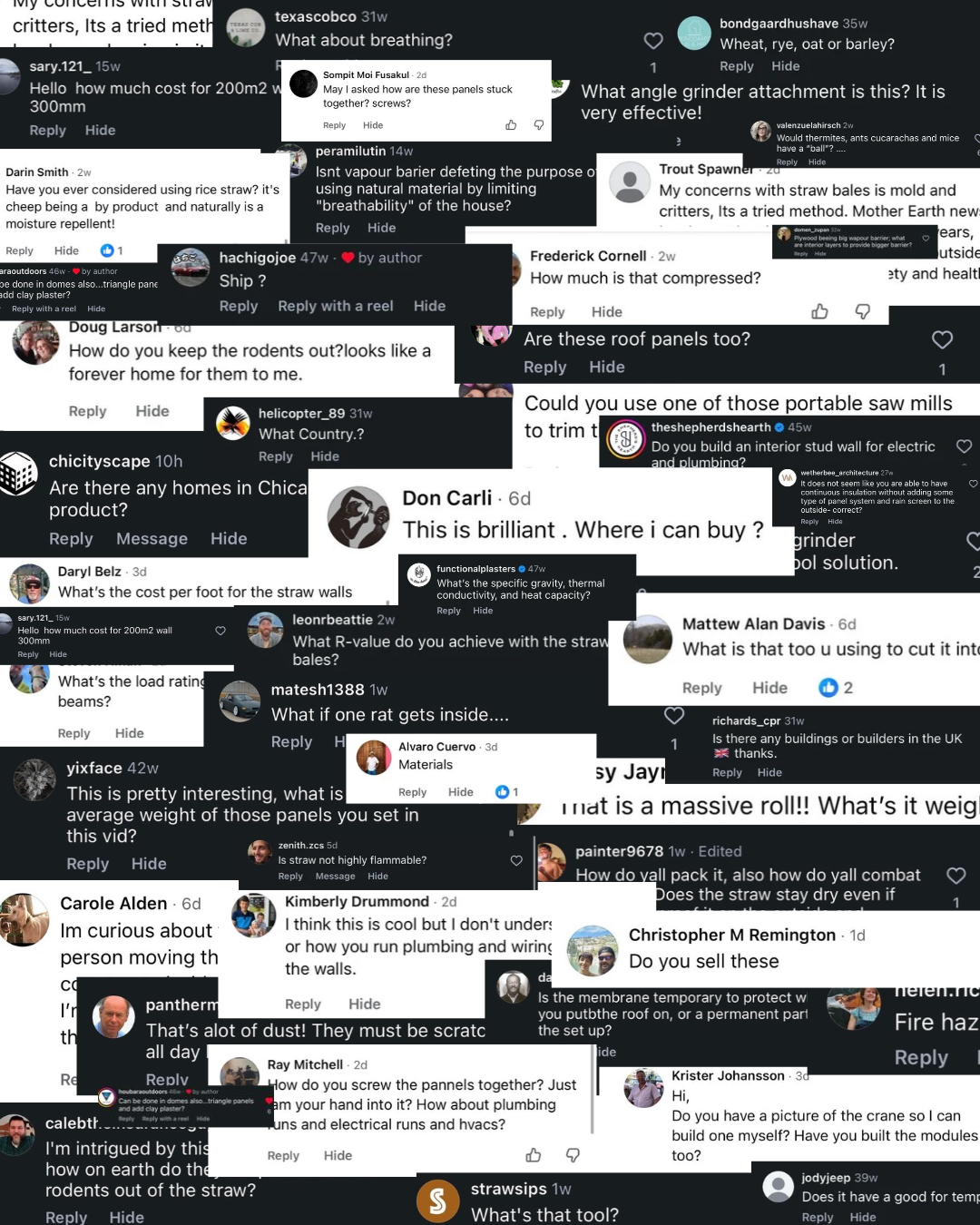
After several of our social media videos have gotten traction, there are a LOT of questions in our comments and DMs. And rightfully so! We are excited that the internet is curious about what we are doing, and we love that people have questions. It is our job to spread the word about what we are doing, and help answer the questions we get.
So, we have gone through and compiled all the comments we have received across the various platforms, and here is an extended FAQ page to answer them!
Have a question we didn’t answer? Email us and we will add it to this running list! If you have questions about your specific project, we can set up a consultation call to go more in depth.
Without further ado, here are the questions:
How are the panels fastened together?
Typically 5/16” 4” long structural GRK screws with 1ft spacing on the exterior and less frequently on the interior. Engineering may vary per project.
How do you keep rodents out?
Straw is different than hay. With straw, the nutrient-dense seed head has already been removed / harvested. Rodents are not interested in straw since it isn’t really a food source. Our straw panels are also very densely packed, so vermin are not able to make a home in it.
How much are the panels compressed?
7-10 lbs per cubic ft
Have you ever considered using rice straw?
We definitely could and it is grown in the boot heel of Missouri! However, wheat straw is grown closer to us. Actually, the straw from any cereal grain can be used (rye, barley, oats are other examples).
Do you sell these panels?
Yes! We do. We sell our panels for custom designs, as well as panel-ready plan sets.
Could you use one of those portable saw mills to trim the straw?
A big bandsaw would be fun to try, but we are currently headed towards router sled style.
Where can I buy (your panels)?
You can start the process by inquiring through our website, and we will reach out to learn more about your project!
What are the mechanics of one person moving a panel?
We typically use a telehandler or a boom truck to move panels. It is possible for a few people to install a shorter (8’ or so) panel without equipment, but it takes longer and the panels are heavy!
What is the tool you are using in your videos to cut the straw?
It is a Comer product from Italy, called the TF-2000 Hay Cutter. We have also created our own straw-trimming tools.
Why not just use square bales?
We used to use square bales and still could! Using loose straw allows us more freedom to create different sized panels, so we are not limited to the dimensions of a square bale.
Do you keep the straw lifted off the ground?
Yes! Panels should never touch the bare ground during fabrication, transport, or install. Panels are typically designed to sit on a toe-up made of two parallel runs of treated 2x4s sitting flat on floor decking or slab. The space between the 2x4s is filled with EPS or mineral wool rigid insulation.
How do you address mold?
A well-detailed straw insulated houses will allow vapor to dry to both the exterior (via an earthen or lime plaster or a vapor permeable membrane with rainscreen furring strips and siding) and interior (via an interior vapor permeable membrane or earthen plaster). Straw, and other cellulose-based materials, have great hygroscopic properties that allow moisture to be distributed throughout its cellular structure. Allowing moisture to disperse within a material and dry quickly prevents moisture build-up that could create conditions for mold growth.
What materials do you use?
Our latest panel design uses Missouri-grown wheat straw and Southern Yellow Pine framing.
Do you have plans for the cranes and equipment so I can build myself?
We offer paid consultation calls with our crew, please inquire through our website!
Are there builders of this in other countries?
Yes! We are aware of several S-SIP producers around the world, mostly in Europe. This map shows locations of known producers as of 2024. We often hear from small-scale panel fabricators around the world who are just starting up or not producing for commercial sales. This is a growing industry!
What is the specific thermal conductivity?
14” wide panels with similar construction methods have been demonstrated to achieve an R-value of ~38.
What about fire?
Straw construction has performed exceptionally well in fire tests, and we even conducted one ourselves to prove it, with a full video on our YouTube channel. Burning compressed straw is like trying to burn a phone book - it will smolder but not catch fire. More information can be found by watching our YouTube video or reading our article featured in the Last Straw Journal, which showcases how one of our clients specifically chose to build with straw panels in a fire-prone location.
Is the vapor membrane temporary?
The vapor open weather barrier will be part of the rainscreen with siding over it.
Will it help keep my house at a good temperature?
Yes!
Where are we located?
We are located in the Midwest, specifically Columbia, Missouri, USA. We are able to service surrounding Midwest states.
Can you use plaster?
Plaster is an excellent finish to pair with straw. When straw is enclosed in natural plaster, it creates a wall system that provides excellent insulation and naturally regulates humidity.
Do you Ship?
Yes, we are able to service and ship panels locally within the Midwest states.
Are there any projects in Chicago that utilize our panels?
Not currently, but Chicago recently updated their ADU ordinance. Our panels would make a great fit for the climate and location of the city!
That is a lot of dust, are we scratching all day?
It can be dusty during fabrication, but we have a dust collection system in our shop and utilize PPE.
What are our panels filled with?
Compressed, locally grown straw.
