
Do Straw Bale Homes Mold? Moisture Control, Durability & Water Protection Explained
Written By Cameron Clapp 2025
Let's talk about the elephant in the room: Water. One of the largest hurdles for addressing strawbale construction is the common concern about moisture. Many people find themselves asking, “is this really safe? Will it rot with time?” These are all real and important questions to ask.
What is Straw Bale Construction?
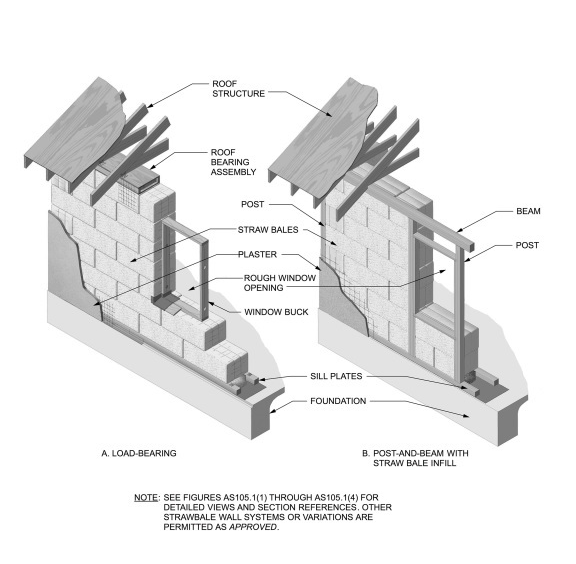
It's true that there are quite a few original strawbale houses built in the early 1900’s that stand today, such as the Pilgrim Holiness Church, finished in 1928 (Nartker, 2024), and it's also true that many didn't make the cut. In the early 1900s, there were no standards in place for proper construction and water management in strawbale buildings, resulting in poorly detailed structures that were demolished after extensive water intrusion such as the Lone Oak Building in Nebraska (Carey, 2023) . We have learned from the past, and over the following decades, standards have been established, including the International Residential Code (IRC), with appendix AS for specifications with strawbale construction standards first added in the IRC 2015 edition. Most of these code requirements today directly combat water risks and act as a multilayered approach to water management.
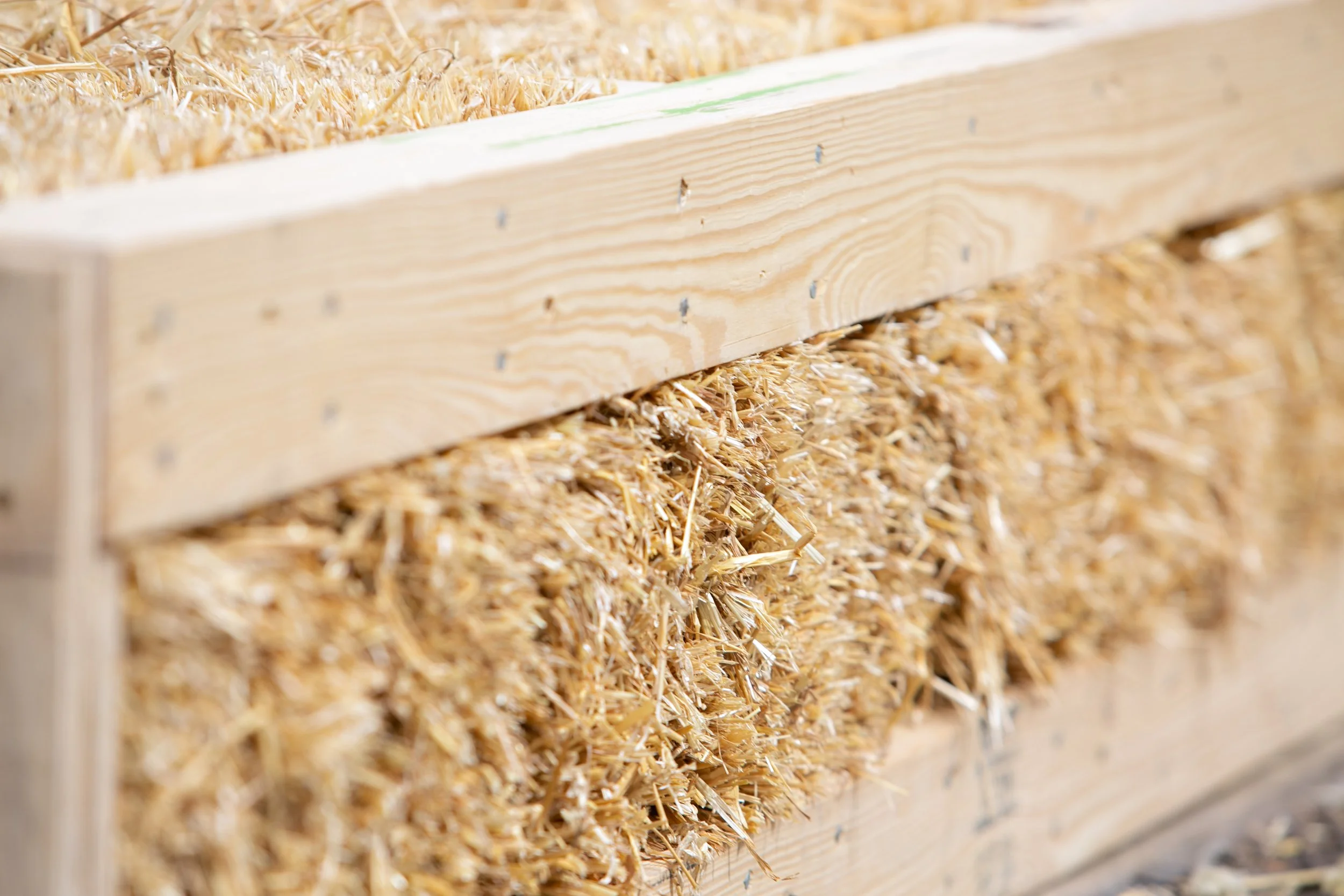
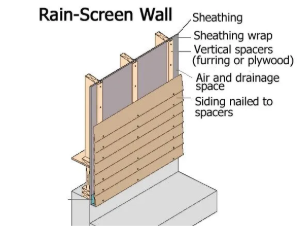
It's important to understand the properties of straw and how they differ from conventional materials. Straw is hygroscopic, meaning it can absorb and release moisture from the surrounding air, kind of like a natural humidity regulator (Song et al., 2024). This helps buffer indoor humidity levels, but it also means you have to manage vapor to avoid buildup. Unlike wood or concrete, straw walls are often finished with breathable plasters, either lime or earth-based, which allow moisture to escape outward. You can also use vinyl siding with a rainscreen – that's an air gap behind the siding that promotes drying and prevents trapped water.
Now when it comes to managing water, it all begins with the base. In order to prevent straw bales from ground moisture, dew points, and condensation, a toe up is required. A toe up is essentially 2x4s laid down on their side with a vapor barrier, which straw bales sit on top of.
This completely breaks connections to the moisture in the ground and potential condensation on the bottom of straw bales by allowing each bale to be slightly raised above the ground (King, 2006).
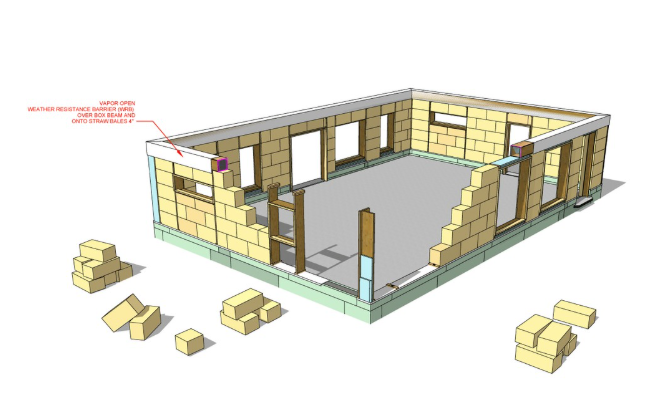
Next, another important spot for moisture management is above the bales on the top plate, by use of a membrane or sheet preventing moisture from entering. This acts to prevent condensation from above or as a secondary shield against potential roof leakage (IRC Appendix AS). Recommended barriers are really any vapor open weather resistive barriers (WRB wraps), particularly with vapor permeance of at least 5 perms as per IRC Appendix AS. Potential options include ones like the SOLITEX MENTO from 475 High Performance Building Materials (Scursso, 2025), as it functions as a breathable barrier allowing it to prevent water intrusion but allowing for moisture to escape rather than be trapped inside the wall assembly
Roof Considerations
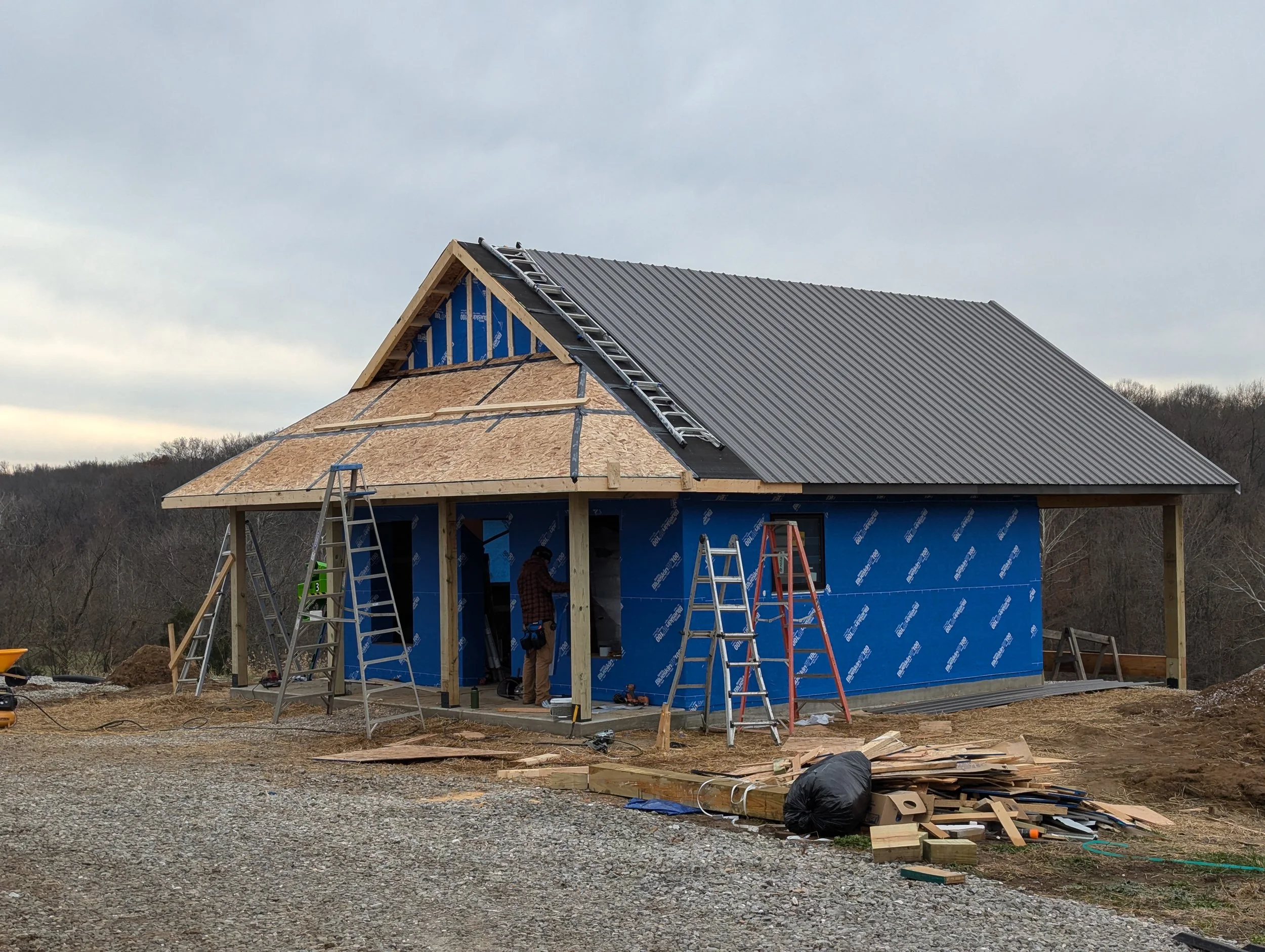
Roof design also gets special attention, with many designs including a roof overhang slightly longer than traditional designs, with overhangs between 1-2 feet (Straube 2009)
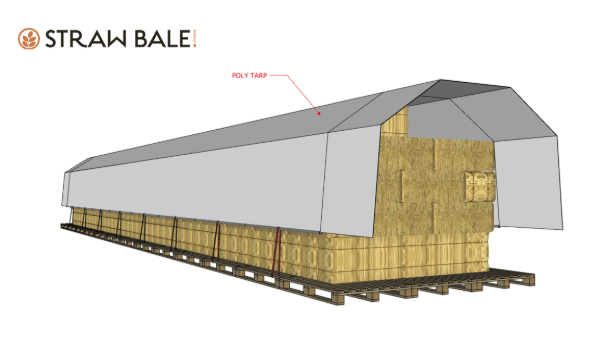
With all of these methods of preventing water intrusion there remains one final obstacle, water intrusion during installation/construction. In typical strawbale construction, this is especially important to pay attention to. As great as all the other methods of preventing water in the built environment are, it's important to focus on water during construction. As mentioned in previous posts, stacking bales manually is a labor intensive process that can take multiple weeks to complete before the walls could be finished and protected. There are methods used to circumvent this, such as paying attention to weather conditions before construction, safe storage of bales in climate-controlled facilities, and covering placed bales with plastic covers after each day during construction. With Prefab design, as mentioned before, this comes down to about a week-long process, with the same methods used to avoid water problems.
If all else fails, then what happens? Will I even know there's a problem?
If one is unlucky enough that somehow water gets through, if it can't breath and dry out and stays soaked above 20 percent moisture content for extended periods of time, it can start to rot and mold (Robinson et al., 2017). This is scary to think of, and in the case that it does happen, it can be identified through cracking and discoloration in the interior plaster around the areas affected. Additionally, there are options like pinless moisture meters and humidity monitoring, which would allow you to identify issues quickly (Robinson et al. 2017). In those cases where bales exceed 20 percent moisture content for extended periods, sections of bales or panels may need to be replaced. Studies like "How Straw Decomposes: Implications for Straw Bale Construction" by Matthew D. Summers, Sherry L. Blunk, and Bryan M. Jenkins emphasize that straw can last for thousands of years if kept dry but decomposes rapidly (e.g., blackening in days) when saturated with moisture and exposed to microbes—making early detection and drying crucial. If identified early enough, small holes can be drilled and fans added to allow for fast drying of those areas while the primary leaks are addressed.
In conclusion, while water is a valid concern in strawbale construction, modern standards, thoughtful design, airtight energy efficient construction, and proactive management make it a reliable and durable building method. By focusing on breathability, protection during construction, and quick responses to any issues, these homes can stand strong for generations, even better than those early 1900s survivors approaching 100 years old.
Sources
firespringInt. (2023, August 21). Huff and puff not enough to destroy this straw building. Nebraska State Historical Society. https://history.nebraska.gov/huff-and-puff-not-enough-to-destroy-this-straw-building/?Nartker, D. (2024, November 5). The 100-year-old Straw Bale Church. Strawbale.com. https://www.strawbale.com/blog/straw-bale-churchScursso, T. (2025, June 1). Protecting the top of walls in Straw Bale Homes. Strawbale.com. https://www.strawbale.com/blog/protecting-the-top-of-walls-in-straw-bale-homes#:~:text=The%20technique%20I%20recommend%20employing,underside%20of%20the%20roof%20rafters.Song, L., Li, Y., Lei, T., Yang, Y., Shen, Y., Yang, M., Wang, Y., & Zheng, H. (2024). Research on the Water Absorption Diffusion Model and Kinetics of Pretreated Straw. https://doi.org/10.21203/rs.3.rs-5404079/v1Straube, J. (n.d.). BSD-112: Building Science for Strawbale Buildings. BSD-112: Building science for strawbale buildings.https://buildingscience.com/documents/digests/bsd-112-building-science-for-strawbale-buildings?
