
Straw Bale Construction Fire Resistance: Tests, Building Codes & Wildfire Survival
Written By Cameron Clapp 2025
Let’s talk about one of the most common concerns that comes up when people first hear about strawbale construction: fire. The mental image is almost always the same—dry straw, a single spark, and a house going up in flames. In reality, a well-built strawbale wall is far more fire-resilient than most people expect, and in many cases, it performs better than a conventional wood-framed wall.
When discussing “alternative” construction methods such as straw, three questions usually rise to the top: Will it stand up? Will it burn down? Will it mold and rot? This post focuses on that middle question and looks at what the testing, the science, and real building case studies tell us about fire and strawbale.
Why Strawbale Walls Don’t Burn Like Loose Straw
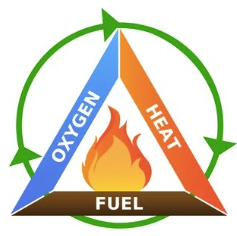
Loose straw burns easily because it has both fuel and oxygen; a fire can weave through the fibers and grow quickly. In a construction-grade strawbale wall, the conditions are completely different from the isolated loose straw. Firstly, the bales are densely compressed and then coated with plaster or other protective layers, which dramatically limits the amount of oxygen available to sustain combustion.
Once a wall is rendered, the outer layer becomes the first line of defense, functioning much like the protective skin on other fire-rated assemblies. Behind that skin is densely packed straw with minimal air space, so even if flame reaches the bale, it tends to char slowly at the surface instead of supporting a fast-moving fire (Teslík, 2021). Straw also contains silica, which is a natural fire retardant (Atik & Ates, 2012). This combination of low oxygen, compacted fuel, and protective render is what allows strawbale walls to achieve fire performance that surprises building officials, insurers, and first-time observers.
Fire Testing and Performance Ratings
Over the past several decades, formal fire testing has moved strawbale construction from being an unverified material to a system with measurable performance. Full-scale wall assemblies—baled, plastered, and built as they would be on a real project—have been subjected to standardized fire tests that measure how long the wall can withstand high temperatures before failure.
Strawbale has grown from hypothetically being fire resistant, to being verified at a 2 hour fire rating.
Plastered strawbale wall assemblies have been tested under ASTM E119, the standard fire test for building components, with walls enduring temperatures around 1,800°F for up to two hours while maintaining structural integrity and room separation (Tlaiji et al., 2022).In addition, baled straw used as insulation has been evaluated under ASTM E84 (surface burning characteristics), where dense, compacted bales showed low flame spread and smoke development, Comparable prefabricated straw panels (such as EcoCocon-type systems) have achieved fire resistance ratings on the order of REI 120 in European testing, demonstrating that factory-built straw wall systems can reliably deliver multi‑hour fire protection. Building Integrity has done independent fire testing with locally manufactured panels, verifying previous tests. Video of the test available on youtube under the video from Building Integrity’s channel, “Straw bale panel burn test”.
Many of these tests show strawbale walls achieving fire resistance ratings on the order of hours, not minutes, exceeding code-compliant framed walls with conventional finishes in residential settings. These results are a key reason strawbale has gained acceptance in regions with strict fire codes and has been incorporated into engineered, permitted buildings rather than remaining an informal, off-grid technique.
Case Studies: Straw Bale and Wildfires
According to https://www.fire.ca.gov/incidents in January of 2025, California lost 16,000 homes due to wildfires, and recent studies state that “The number of homes destroyed by wildfires has doubled over the past 30 years” (Radeloff et al. 2023).
Laboratory tests are one thing; wildfire events are another. Over the years, several documented wildfire incidents have involved strawbale buildings in the path of advancing flames. In many of these case studies, the strawbale structures either remained standing with repairable damage or performed on par with, and sometimes better than, neighboring conventional buildings.
CASBA, California Straw Building Association, found and collected cases of the straw buildings which survived wildfires and published them in their newsletter. They mentioned one house in Sonoma CA which survived an inferno, flames burned all the way to the foundation, but were not able to spread up straw walls, which were coated in a lime plaster.
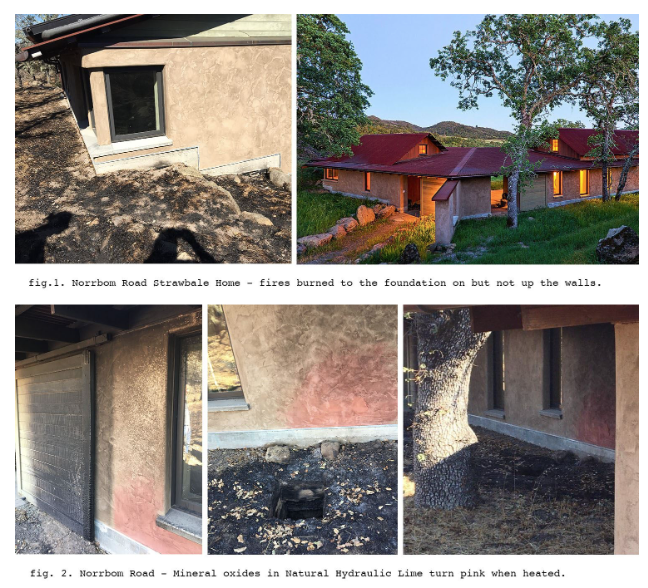
CASBA mentioned three more case studies, Lovall Valley, with surrounding houses burning to the ground, but the strawbale home on Lovall Valley Loop withstanding the fire with no damage to the house. Another Example at Redwood Valley Residence with outbuildings and neighboring homes burned and the valley residence surviving unscathed. Finally they cite another case study called the Napa Studio burning in the Atlas fire, which was constructed with three of the four exterior walls being straw. In this case, the non straw wall burned first, and spread to the roof, burning down all but the three walls of straw.
In wildfire scenarios, what often makes the difference is not only the inherent fire resistance of the wall but also attention to defensible space, roof design, ember protection, and detailing around openings. Where these fundamentals were handled well, strawbale buildings have shown remarkable resilience: exterior plasters may crack, finishes may be smoke-stained, and windows may fail, but the bale walls themselves tend to resist complete burn-through. These real-world outcomes support what the test data already suggests—when designed thoughtfully, strawbale can be part of a robust wildfire strategy rather than a liability.
Looking Ahead: Prefab Panels and Verified Safety
As strawbale construction evolves into prefabricated panel systems, fire behavior becomes even more predictable and testable. Panels manufactured in controlled environments allow for consistent bale density, repeatable render or sheathing systems, and standardized details that can be modeled, tested, and certified.
For practitioners, this means moving from anecdotal reassurance to documented performance: specific wall types with known fire ratings, tested assemblies that can be referenced in permitting, and a growing body of data from both labs and real projects. In this way, strawbale construction is following the same trajectory as other high-performance systems—using testing, iteration, and engineering to turn a natural material into a dependable, codified building product.
Sources
Atik, C., & Ates, S. (2012). Mass balance of silica in straw from the perspective of silica reduction in straw pulp. BioResources, 7(3), 3274–3282. https://doi.org/10.15376/biores.7.3.3274-3282
Teslík, J. (2021). Analysis of the Fire Properties of Blown Insulation from Crushed Straw in the Buildings. Materials, 14(15), 4336. https://doi.org/10.3390/ma14154336Janowska-Renkas, E., Król, A., Pochwała, S., Pałubski, D., Adamska, M., & Klementowski, I. (2022). The fire resistance and heat conductivity of natural construction material based on straw and numerical simulation of building energy demand. Energies, 15(3), 1155. https://doi.org/10.3390/en15031155Casba. California Straw Building Association (CASBA) - Fire-resistive Straw Bale Walls Survive North Bay Fires. (n.d.). https://www.strawbuilding.org/news/5629341?emulatemode=2 Flowering elbow. Flowering Elbow " Blog Archive " Destruction Testing Straw Bale Construction. (n.d.). https://www.floweringelbow.org/destruction-testing-straw-bale-construction/
